
Remote Data Acquisition for Environmental Monitoring: What Manufacturers Can Learn From Lightweight System Design
Remote Data Acquisition for Environmental Monitoring: What Manufacturers Can Learn From Lightweight System Design
Collecting one analog signal and exporting it to a CSV file can sound like a small task. In practice, projects like this often reveal a bigger engineering question: how much software, infrastructure, and system overhead does the application actually need?
That question matters in environmental monitoring, and it matters just as much across manufacturing. Engineers are often asked to gather useful data from equipment that operates outside a traditional control room, outside a stable plant network, or outside the kind of environment where a full HMI or SCADA stack makes sense. In those situations, the best solution is not always the most feature-rich one. More often, it’s the one that fits the operating conditions and gives the user exactly what they need. Just as importantly, it should stay easy to support over time.
This is where lightweight data acquisition becomes a valuable engineering strategy. When the goal is clear signal capture, local storage, simple visibility, and practical export, a focused solution can outperform a larger industrial software platform that brings extra cost and complexity without adding much value to the user.
In applications like this, the core requirements are usually straightforward:
- Capture the signal reliably
- Store the data locally
- Give the user basic live visibility
- Export the data in a practical format
- Keep the system easy to deploy and support
Remote Data Acquisition Challenges in Environmental Monitoring
Environmental monitoring applications create a set of constraints that many factory systems don’t have to manage in the same way. Equipment may need to travel between locations, operate in remote areas, or run on field laptops without consistent internet access. The user may need to collect data quickly, confirm readings in real time, and hand off a usable file without relying on cloud tools, remote servers, or licensed runtime software.
In those conditions, the technical challenge is not limited to reading a signal. The system also needs to be deployable, understandable, and dependable for a user who is working in the field rather than at a permanent operator station. That changes the design priorities.
For this kind of application, the software needs to start easily, run locally, and avoid introducing support requirements that feel out of proportion to the problem being solved. If a system depends on any of the following, it may work on paper while creating friction in daily use:
- A complicated activation process
- Always-on background services
- Recurring software fees
- Constant internet connectivity
- Extra IT support for a small field application
Those same realities show up in manufacturing more often than people think. Similar constraints come into play on mobile skids, temporary test setups, remote utilities, pilot equipment, and legacy assets that need a basic layer of data collection without a full controls overhaul.
Why Lightweight Systems Can Be the Better Engineering Choice
Industrial automation teams have access to powerful software platforms, and in the right application, those tools are the correct choice. If a system needs plant-wide visibility, alarm handling, historian integration, multi-user access, or long-term expansion across multiple assets, a full HMI or SCADA environment may be justified.
The problem is that many applications do not actually require all of that. Engineers sometimes end up forcing a straightforward data collection need into a larger software framework because that is the familiar path. When that happens, the software stack can become more difficult to install, maintain, and support than the underlying process itself.
A lightweight system avoids that trap by staying aligned with the real requirement. If the job is to do the following work cleanly and reliably, then the best design may be the one that does exactly that and nothing more:
- Capture an analog value
- Convert it into usable digital data
- Log it locally
- Show the current reading
- Export a file that the customer can work with
This is not about avoiding industrial-grade thinking; it’s about applying it correctly. Strong engineering is not measured by how much software gets added to a system. It’s measured by whether the solution is reliable and appropriate for the environment where it will actually be used.
Offline Data Logging for Industrial and Field Applications
Offline capability is one of the most practical design requirements in remote monitoring. It’s also one of the most overlooked.
When internet access is unstable or unavailable, the system still has to do its job. That means reading incoming values, storing them locally, and giving the user confidence that the data is being captured correctly. If logging stops when a connection drops or if exporting data depends on access to an outside service, the application becomes harder to trust.
For many industrial and environmental applications, local-first design is the safer choice. Data should live on the machine performing the work. The user should be able to review it without waiting on a network dependency. Exporting should be immediate and practical, especially when the end goal is to review the data in a familiar tool like Microsoft Excel.
This is one reason CSV remains so useful in industrial workflows. It’s not flashy, but it’s portable, readable, and widely understood. Engineers, technicians, and operations teams can sort it, graph it, archive it, and share it without needing specialized software. That simplicity often makes the system more valuable, not less.
Modbus, 4–20 mA Signals, and Practical Legacy Data Integration
A large percentage of industrial equipment still depends on familiar signal standards such as 4 to 20 mA. That is not a limitation. It’s just a reminder that useful modernization often starts by making existing signals easier to access, interpret, and store.
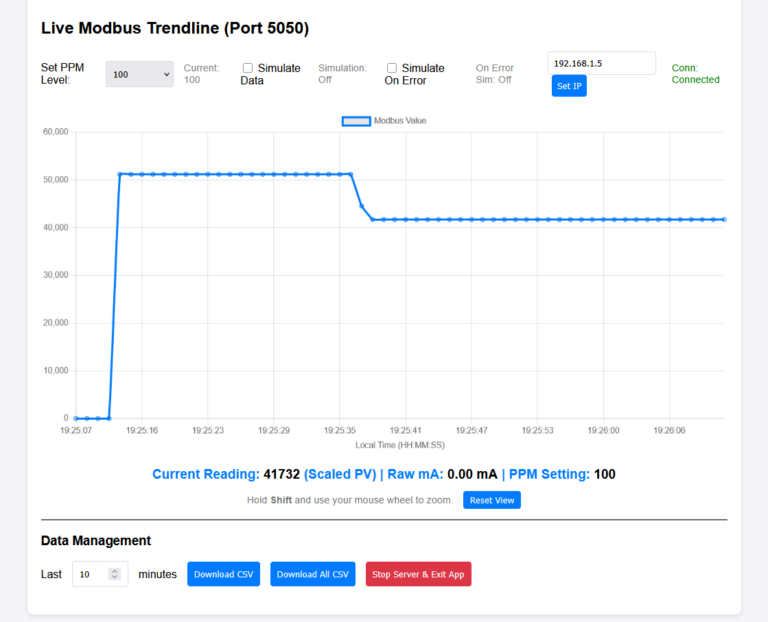
In many facilities, the problem isn’t that data doesn’t exist. The problem is that the data is trapped inside instrumentation, isolated in a controller, or available only through software that is too specialized for everyday use. Converting an analog measurement into digital data through a common protocol such as Modbus is often a practical first step toward better visibility.
That kind of integration work matters well beyond environmental monitoring. Manufacturers deal with the same need when they want to pull useful information from systems such as:
- Legacy sensors
- Standalone analyzers
- Test equipment
- Older process skids
- One-off or temporary monitoring setups
They may not need a full platform migration right away. Instead, they may just need a dependable way to capture and export the information they already have. This is where focused engineering can create momentum. A right-sized data acquisition layer can help a team prove value and make better decisions before taking on a larger modernization effort.
How Simple Data Export Improves Engineering and Operations Workflows
The value of a data acquisition system does not stop at collection. It depends on whether the information is easy to use once it has been captured.
This is where many otherwise capable systems fall short. Common problems tend to look like this:
- The signal is technically available, but buried in proprietary software
- Reviewing the data requires extra conversion steps
- The file format is not practical for the end user
- Someone has to explain the setup every time the data is needed
- Reporting becomes slower than it should be
All of that slows down troubleshooting and limits how often the data actually gets used.
A better approach is to make the output fit the workflow. When engineers can open a file immediately, confirm readings, build a graph, compare runs, or send results to another team without friction, the system becomes more useful across the operation. That kind of accessibility is especially important in field applications, where the person collecting the data may also be the one responsible for interpreting it and reporting on it.
In manufacturing, this same principle supports quality checks, process verification, equipment troubleshooting, temporary studies, and pilot runs. Data becomes more actionable when it’s stored in a format that the working team can use without delay.
What Manufacturers Should Consider Before Choosing a Remote Data Acquisition Platform
When a new data acquisition need comes up, it helps to step back before defaulting to a familiar software stack. A few early questions can save significant time and cost later:
- Where will the system operate?
- Who will use it day to day?
- What does the data actually need to do?
- Does the application need to run offline?
- What will it take to maintain the solution over time?
These are practical questions, not theoretical ones. The best data acquisition platform is the one that solves the current problem cleanly while leaving room for the next step when the process actually needs it.
Lightweight Automation Solutions for Real-World Operating Conditions
One of the most useful shifts in modern automation is the growing willingness to build solutions around real operating conditions rather than software conventions. That approach leads to better outcomes because it treats deployment, usability, and maintainability as core engineering requirements rather than afterthoughts.
In some projects, the right answer is a broad industrial platform with all the structure and scalability that comes with it. In others, the right answer is a purpose-built application that captures the signal, logs the data, gives the user visibility, and stays out of the way.
For remote data acquisition and many similar manufacturing applications, that second path can be the smarter one. A lightweight system can be easier to support because it avoids the extra software burden that often comes with a heavier platform. It also helps put useful data in front of the user faster. Most importantly, it gives the end user a tool that fits the way the work is actually done. After all, the goal isn’t to build the biggest possible system. The goal is to build the right one.
Ready to Transform
Your Operations?
Let us help you achieve measurable success and drive innovation in your business.
Contact Cleveland Automation Systems™ today for a personalized consultation.

About the Author: Rylan Pyciak
Rylan Pyciak, CEO of Cleveland Automation Systems™, is a Systems and Control Engineering graduate from Case Western Reserve University. With expertise in PLCs, robotics, and industrial engineering, Rylan leads CAS in delivering innovative automation solutions. Passionate about mentoring future trades professionals, he combines technical knowledge with a commitment to fostering sustainable growth in manufacturing.